Why 146?
 Impact & Programs
 About
About Learn
Learn Ways to Give
 Videos & Articles
 Publications
 Get Involved
 Parenting
 Resources
 Prevention Curriculum
 Contact Us
Public awareness of trafficking has grown substantially in recent years, but much of that awareness stops at headlines and statistics. Fewer people know what actually happens after someone picks up the phone and makes a call.
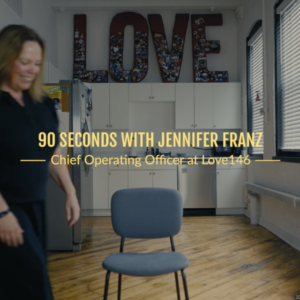
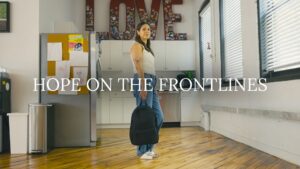
Love146 is Connecticut’s primary provider of specialized services for children who experience trafficking victimization. One woman processes every referral that comes to Love146, a role that puts her at the center of the many urgent moments of intervention. Our new documentary follows her work, built around two moments: a referral and a backpack.

How to Recognize the Increased Risks for Child Trafficking
Referrals reach her from schools, guardians, hotlines, and other service providers, often built on a handful of observations rather than certainty. A young person pulls away from friends and activities they used to care about. Grades slip, or attendance drops off entirely. A parent notices contact with an unfamiliar adult through a gaming platform, a dating app, or social media.
She works through a decision map built around those indicators: sudden shifts in mood or behavior, signs of coercion or control, engagement with apps and platforms known to be used for grooming. The goal is to move fast without overreacting, and to give a worried caller something they rarely expect to hear right away. “You have called the right place,” she says in the film.
For the adult on the other end of the line, the hardest part is often not knowing what comes next. She tries to close that gap immediately. “This is a burden I will share with you,” she tells callers. “You can call, you can text, you can email, and I’ll respond.”

What Is a Rapid Response for a Trafficking Survivor?
When a case calls for it, our team deploys a Rapid Response: a one-time, individualized intervention for youth who are at high risk for, or suspected or confirmed to be, survivors of trafficking.
A session typically covers the realities of child trafficking, common recruitment and grooming tactics, behaviors that increase vulnerability, what a healthy relationship looks like, and internet safety. For many young people, it’s the first time someone has walked them through what grooming and exploitation actually look like, in language built around their own safety rather than judgment. Afterward, our team completes a written summary of what was discussed and what follow-up support is recommended. Sometimes that means referring youth into our long-term Survivor Care Program
Every young person who goes through a Rapid Response also receives a backpack, built as a harm reduction tool rather than a formality. The contents have changed over time as youth and providers have told us what actually helps: softer blankets, snacks, hotline cards tucked discreetly inside coloring books so a young person can carry them without anyone else knowing they’re there. Chapstick, gloves, a stress ball, small things that signal someone thought carefully about what this day is actually like.
And on top of every backpack is a teddy bear.

She recalls hearing about one young person who took the bear, hugged it immediately, and gave it a name on the spot. “We’ve chosen the best bears. The bears have auditioned to be in this backpack,” she says. Chief Programs Officer Erin Williamson remembers giving a backpack to a young person who dug through it, found the chapstick, and asked her, “How did you know I needed chapstick?” Each backpack is packed with love, by staff and by volunteers who gather to fill them one item at a time.

Survivor Care Starts With Hope
The documentary closes on something harder to capture on camera: what it costs to do this work, and what keeps someone doing it anyway. She describes reading referral after referral from a place of physical and emotional safety, aware that the young person in the file may not have that same safety right now. That awareness, she says, is part of what drives her forward.
It’s also what makes the wins land so hard. Hearing that a former client graduated from college. Getting a call years later from someone who wants to reconnect and share good news. Those celebrations move through the whole organization, because everyone involved in supporting this work shares in the tough times and the joys.
“It’s almost a luxury to have hope,” she says. “I’m okay with just carrying the hope with me that things are going to get better.”
That hope is built into a decision map, a Rapid Response session, and a backpack packed with love, a teddy bear placed on top so it’s the first thing a young person sees. Keeping that system running for every referral that comes in takes real, ongoing support
If you or someone you know may be experiencing trafficking, help is available. Call the National Human Trafficking Hotline at 1-888-373-7888, or text 233733.
If this film moved you, consider supporting the work behind it. A gift to Love146 helps fund Rapid Response sessions, backpacks, and follow-up care for young people who need them most. Donate today to help us keep showing up.